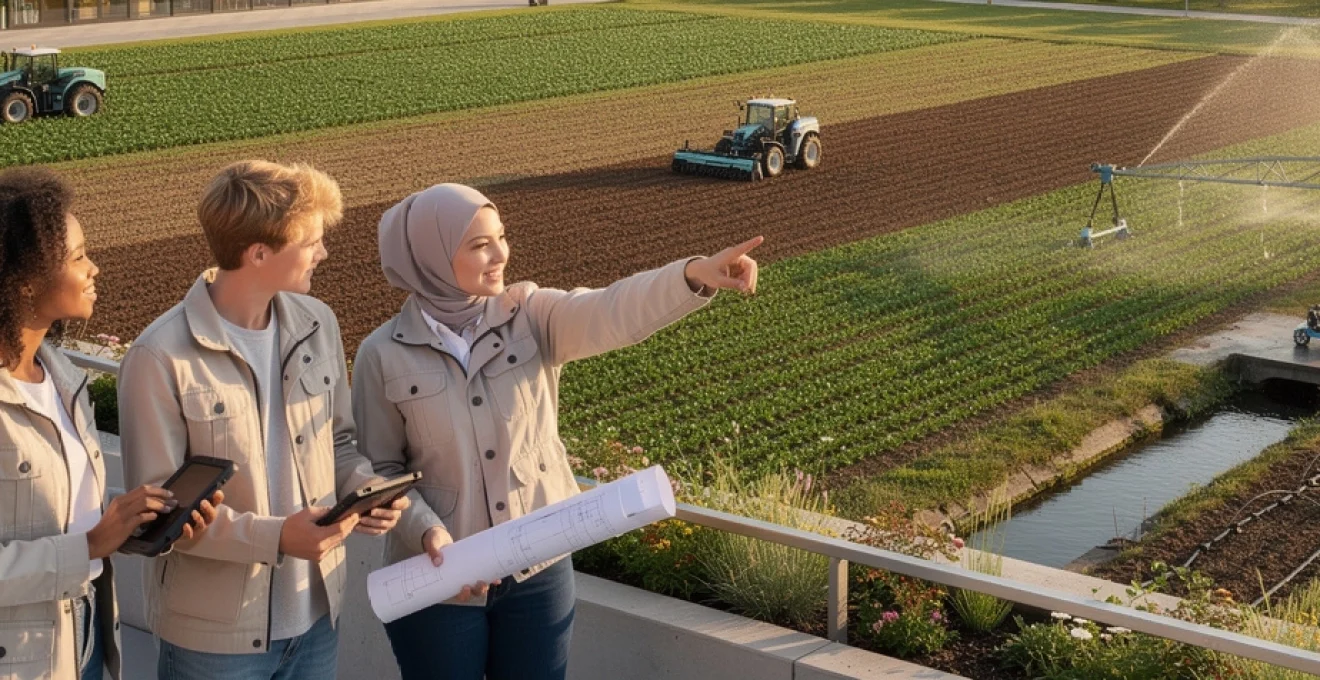
Agricultural engineering stands at the crossroads of traditional farming wisdom and cutting-edge technological innovation. As global food security challenges intensify and sustainable farming practices become non-negotiable, the demand for qualified agronomic engineers has reached unprecedented levels. These specialists combine mechanical engineering principles with agricultural science to revolutionize how we produce food, manage natural resources, and address environmental concerns. For prospective students considering this rewarding field, selecting the right educational institution represents a critical decision that will shape your entire professional trajectory. With graduate employment rates in agricultural engineering consistently exceeding 95% across leading institutions, the investment in quality education pays substantial dividends throughout your career.
The agricultural sector faces transformative changes driven by precision technologies, climate adaptation requirements, and evolving regulatory frameworks. Modern agronomic engineers design autonomous farming equipment, develop sophisticated irrigation systems, implement remote sensing technologies, and create solutions for soil conservation. This breadth of responsibility requires comprehensive training from institutions that balance theoretical rigour with practical application. The right engineering school provides not just academic credentials but also industry connections, research opportunities, and hands-on experience that distinguish exceptional graduates from merely competent ones. Understanding what separates world-class agronomic engineering programmes from average offerings will position you to make an informed choice that aligns with your career aspirations.
Accreditation standards and recognition bodies for agronomic engineering programmes
Before committing to any agronomic engineering programme, you must verify its accreditation status and professional recognition. Accreditation serves as your guarantee that the curriculum meets rigorous educational standards and that your qualification will be recognised by employers across international borders. Various accreditation bodies operate across different regions, each maintaining specific criteria for programme approval. These standards ensure graduates possess the competencies required for professional practice and continuous development throughout their careers.
EUR-ACE framework and european network for accreditation of engineering education (ENAEE) certification
The EUR-ACE framework establishes quality assurance standards for engineering programmes across European higher education institutions. This system provides international recognition through a standardized evaluation process that examines curriculum design, learning outcomes, faculty qualifications, and resource availability. Programmes bearing EUR-ACE accreditation have demonstrated compliance with these rigorous benchmarks, ensuring graduates meet European-wide competency standards in engineering education. This certification facilitates professional mobility across European Union member states and increasingly receives recognition in non-European countries seeking quality assurance mechanisms.
EUR-ACE accreditation evaluates seven primary programme outcome areas including knowledge and understanding, engineering analysis, engineering design, investigations, engineering practice, transferable skills, and making judgements. For agronomic engineering specifically, accredited programmes must demonstrate how they develop competencies in agricultural systems, biological processes, and sustainable resource management. This comprehensive approach ensures you receive well-rounded preparation that balances technical expertise with broader professional capabilities essential for leadership roles in the agricultural sector.
Royal agricultural society of england (RASE) professional endorsement
The Royal Agricultural Society of England offers professional endorsement for agricultural and land-based engineering courses throughout the United Kingdom. RASE endorsement signifies that a programme meets industry-defined standards and prepares graduates for immediate contribution within agricultural enterprises. This recognition involves detailed curriculum review by practicing professionals who assess whether course content reflects current industry practices, emerging technologies, and employer expectations. RASE-endorsed programmes typically feature strong industry partnerships, substantial practical components, and clear pathways to professional development.
For students targeting careers within British agriculture or Commonwealth countries with similar agricultural frameworks, RASE endorsement provides valuable credibility. The endorsement process examines teaching quality, facilities and equipment, industrial placement opportunities, and graduate employment outcomes. Programmes undergo periodic reassessment to ensure continued alignment with evolving industry needs. This dynamic approach means RASE-endorsed qualifications remain relevant throughout rapid technological changes affecting modern agriculture.
Institution of agricultural engineers (IAgrE) chartered status pathways
The Institution of Agricultural Engineers offers chartered engineer status to qualified professionals demonstrating advanced competency in agricultural engineering practice. Many agronomic engineering programmes provide direct pathways toward this prestigious professional recognition. IAgrE-accredited degrees meet the educational requirements for chartered status, allowing graduates to pursue professional registration through supervised experience and professional review rather than requiring additional academic qualifications. This integrated approach accelerates your progression toward senior engineering roles and consultancy positions.</p
When comparing agronomic engineering schools, you should therefore check whether their degrees are recognised by IAgrE as meeting the academic base for Incorporated Engineer (IEng) or Chartered Engineer (CEng) registration. This typically requires a combination of an accredited bachelor’s and master’s degree or an integrated master’s. Choosing an IAgrE-recognised route not only strengthens your CV but also signals to employers worldwide that your training meets robust professional standards and that you are committed to lifelong professional development and ethical engineering practice.
CTI commission des titres d’ingénieur validation for french agronomic schools
In France, the Commission des Titres d’Ingénieur (CTI) is the sole authority empowered to accredit engineering programmes and award the protected title ingénieur diplômé. For agronomic and agricultural engineering schools, CTI validation guarantees that programmes meet national and European standards for workload, academic depth, and professional competencies. CTI-accredited agronomic schools typically combine strong scientific foundations with significant time spent on real-world projects, industrial placements, and international mobility.
When you see that a French agronomy school is CTI-accredited, you know that the degree confers the full legal and professional status of an engineer in France and is aligned with European higher education frameworks. This accreditation is particularly important if you plan to work in regulated engineering roles, pursue a PhD, or later apply for EUR-ACE or national chartered status. For international students, CTI accreditation also simplifies the recognition of your agronomic engineering qualification in other European countries and beyond.
Leading european engineering schools with agronomic specialisations
Once you understand which accreditation and recognition bodies matter, the next step is to evaluate specific institutions. Europe hosts several world-leading engineering schools that specialise in agronomy, agricultural engineering, and life sciences. While each has its own strengths, they all share common features: rigorous scientific training, strong links with industry, extensive research infrastructure, and a clear focus on sustainable agriculture. Exploring these examples will give you a benchmark for what to expect from a top-tier agronomic engineering school.
Agroparistech institut des sciences et industries du vivant et de l’environnement
AgroParisTech, based in Paris and part of the Université Paris-Saclay ecosystem, is one of Europe’s most prestigious institutions for life and environmental sciences. Its engineering programmes in agronomy and agricultural sciences are CTI-accredited and recognised across Europe through the EUR-ACE framework. Students follow a demanding curriculum that blends plant and animal sciences, environmental engineering, data analysis, and management, often with options to specialise in areas such as sustainable cropping systems, agri-food supply chains, or environmental assessment.
One of AgroParisTech’s major advantages is its deep integration with national research institutes such as INRAE (French National Research Institute for Agriculture, Food and Environment). This creates numerous opportunities for students to participate in cutting-edge research on climate-resilient crops, precision agriculture, and agroecology. If you are looking for an agronomic engineering school where you can move seamlessly between research, consultancy, and industry roles, AgroParisTech offers a powerful platform and a highly international alumni network.
Wageningen university & research agricultural engineering department
Wageningen University & Research (WUR) in the Netherlands consistently ranks among the top universities worldwide for agriculture and forestry. Its agricultural engineering and biosystems engineering programmes are known for their strong quantitative focus and integration of engineering with biological systems. Courses typically cover topics such as robotics in agriculture, controlled environment agriculture, post-harvest technology, and environmental technology, all underpinned by solid training in mathematics, physics, and computer science.
WUR’s teaching and research facilities are among the most advanced in Europe, including experimental farms, greenhouse complexes, and high-tech laboratories. Many programmes are taught in English, which makes Wageningen particularly attractive if you are a non-Dutch speaker seeking an international agronomic engineering experience. Through internships and joint projects with leading agri-tech companies, you will be exposed to real-world challenges from early in your studies, preparing you for roles in agri-robotics, sustainable supply chain design, and large-scale farm systems management.
University of hohenheim agricultural sciences faculty in stuttgart
The University of Hohenheim in Stuttgart, Germany, is renowned for its Faculty of Agricultural Sciences and long tradition in agricultural innovation. Its agricultural engineering and agronomic programmes are structured to give you a broad grounding in crop science, soil science, and livestock systems, while also allowing technical specialisation in areas like farm machinery, process engineering, or renewable energy from biomass. German engineering standards, combined with a strong research culture, make Hohenheim a compelling option if you are looking for depth in both theory and application.
Hohenheim collaborates closely with industry partners from the machinery, automotive, and environmental technology sectors, which is particularly beneficial if you are interested in designing and testing new equipment or systems. Many master’s programmes offer English-taught tracks, and students often participate in European research consortia focusing on themes such as climate-smart agriculture and circular bioeconomy. This combination of regional strength and international outlook is ideal if you plan to work in multinational agribusiness or research organisations.
Cranfield university silsoe campus precision agriculture programmes
In the UK, Cranfield University has developed a strong reputation for applied research and postgraduate education in agricultural engineering and precision agriculture. Although the historical Silsoe Campus has been integrated into the wider Cranfield estate, its legacy continues through specialised MSc programmes and research centres dedicated to soil management, water engineering, and agri-tech innovation. Cranfield’s focus is almost exclusively postgraduate, making it particularly suitable if you already hold a bachelor’s degree and want to specialise further.
Programmes in agricultural engineering, land management, and precision agriculture at Cranfield typically involve intensive taught modules followed by an industry-linked research project. You might work on topics such as autonomous field vehicles, variable rate fertiliser application, or decision-support tools using big data and machine learning. Because Cranfield works closely with agribusiness companies, technology suppliers, and government agencies, graduates are highly sought after for roles in consultancy, research, and high-level technical management.
Montpellier SupAgro institut national d’études supérieures agronomiques
Montpellier SupAgro, now part of Institut Agro Montpellier, is another leading French institution dedicated to agronomy, sustainable agriculture, and food systems. Situated in a region with diverse Mediterranean cropping systems, SupAgro offers CTI-accredited engineering programmes that cover agronomic engineering, tropical agronomy, viticulture and oenology, and rural development. The school has a pronounced international orientation, with a large share of students and staff coming from outside France and numerous joint programmes with universities in Africa, Latin America, and Asia.
As a student at Montpellier SupAgro, you will benefit from experimental farms, pilot wineries, and laboratories devoted to plant protection, irrigation management, and agroecology. Many tracks include extended internships abroad, which is particularly valuable if you aim to work in international development, NGO projects, or global agribusiness. If your goal is to combine solid engineering skills with an understanding of socio-economic and policy dimensions of agriculture, this type of agronomic school offers a well-rounded preparation.
Curriculum components and technical specialisations in agronomic engineering
While each agronomic engineering school has its own flavour, top programmes share a number of core curriculum components. You can think of the degree as a three-layer structure: a foundation in life and physical sciences, a professional layer of engineering tools and methods, and a specialisation layer where you dive deeply into particular technologies or systems. Understanding how these elements are combined will help you evaluate whether a programme truly equips you for the kind of agricultural engineering career you envision.
Precision agriculture technologies: GIS, remote sensing, and variable rate application systems
Precision agriculture has rapidly moved from an emerging concept to a cornerstone of modern farm management. In a strong agronomic engineering curriculum, you should expect dedicated modules on geographic information systems (GIS), remote sensing, and data analytics. These tools allow you to collect, process, and interpret spatial data on soil, crops, and weather, turning complex field variability into actionable management zones. It is a bit like moving from black-and-white television to high-definition streaming: the same field, but with far more detail and control.
Courses in precision agriculture typically cover sensor technologies, drone and satellite imagery, yield mapping, and variable rate technology (VRT). You will learn how to design and calibrate systems that adjust seed rate, fertiliser, and pesticides across a field based on real-time or map-based data. Many programmes also integrate coding and decision-support software, so you can build or customise tools that help farmers reduce input costs while improving yields and environmental performance. If you are interested in data-driven farming or agri-tech start-ups, make sure the schools you consider offer a robust precision agriculture track.
Soil mechanics, pedology, and sustainable land management engineering
Soil is the engineer’s “foundation” in agriculture, much like concrete is for a civil engineer. High-quality agronomic engineering programmes dedicate substantial time to soil science (pedology) and soil mechanics. You will study soil formation, classification, physical and chemical properties, and how these influence crop growth and water movement. From an engineering perspective, this knowledge underpins decisions about machinery selection, traffic patterns, drainage design, and erosion control.
In the context of climate change and environmental regulation, sustainable land management modules become even more important. You will explore techniques such as conservation tillage, controlled traffic farming, terracing, and buffer strips to reduce erosion and protect water quality. Some programmes go further, integrating landscape-scale planning, carbon sequestration strategies, and nature-based solutions. If a curriculum treats soil merely as a static medium rather than a dynamic resource to be engineered and protected, it may not be fully aligned with the demands of sustainable agronomy.
Agricultural machinery design and farm mechanisation systems
Agricultural machinery and farm mechanisation are at the heart of agronomic engineering. A comprehensive programme will take you from basic mechanical design and materials science through to complex systems analysis of entire machinery fleets. Courses often include kinematics, hydraulics, power transmission, and control systems, allowing you to understand how tractors, harvesters, and specialised implements are designed, tested, and optimised. You might work with CAD software, finite element analysis, and test benches to evaluate performance and durability.
Beyond individual machines, you will examine mechanisation strategies for different farm sizes and production systems. For example, how do you design machinery solutions for smallholder farms in developing countries versus highly automated operations in Western Europe? Some schools maintain their own machinery fleets and workshops, giving you hands-on experience with diagnostics, maintenance, and retrofitting of precision agriculture components. If you are drawn to the mechanical side of agronomy, pay attention to the depth of these modules and the availability of workshops, laboratories, and field trials.
Irrigation engineering, hydrology, and water resource management
With agriculture accounting for around 70% of global freshwater withdrawals, irrigation engineering and water management are critical parts of any serious agronomic engineering curriculum. You will study basic and applied hydrology, learning how water moves through catchments, soils, and plants. Building on this, irrigation engineering modules cover the design, operation, and optimisation of systems ranging from simple surface irrigation to advanced drip and sprinkler networks with automated control.
Effective programmes integrate technical design with environmental and socio-economic considerations. You might, for instance, analyse the trade-offs between water use efficiency, energy consumption, and crop yield, or evaluate the impacts of irrigation development on downstream ecosystems. Increasingly, schools incorporate tools such as remote sensing for evapotranspiration estimation and decision-support systems for irrigation scheduling. If your ambition is to work in arid or semi-arid regions, or in international development projects, look for programmes with strong emphasis on water resource management, drought resilience, and integrated watershed planning.
Industry partnerships and research infrastructure requirements
When choosing an engineering school specialising in agronomy, it is tempting to focus only on course titles and rankings. Yet the strength of industry partnerships and the quality of research infrastructure often have a greater impact on your day-to-day learning and long-term career prospects. Ask yourself: will this school allow me to test my skills on real farms, use state-of-the-art equipment, and build a network with companies and research organisations that can hire me later?
Robust industry partnerships usually manifest in several ways: compulsory internships with agricultural machinery manufacturers or agribusiness firms, joint research projects, guest lectures from practitioners, and sponsorship of student projects. Schools with long-standing collaborations often participate in technology trials, on-farm demonstrations, and innovation platforms, giving you a front-row seat to how new agronomic engineering solutions are developed and commercialised. This practical exposure not only enriches your CV but also helps you confirm which niche of the wide agricultural engineering sector suits you best.
On the research side, leading agronomic engineering schools invest heavily in infrastructure such as experimental farms, greenhouses, controlled-environment chambers, sensor networks, and dedicated machinery test tracks. Think of these as your “laboratories in the field” where theoretical concepts are translated into tangible results. For instance, precision agriculture research may require fleets of instrumented tractors, UAVs, and smart implements, while soil and water engineering work demands lysimeters, flumes, and advanced analytical equipment. Before applying, review whether the school provides access to such facilities or partners with nearby research stations and private companies to fill any gaps.
Finally, consider whether the institution is involved in international research consortia and funded projects in areas that interest you, such as climate-smart agriculture, digital farming, or circular bioeconomy. Participation in these initiatives often creates opportunities for funded master’s theses, paid research assistantships, and overseas fieldwork. For a student aiming at a high-impact agronomic engineering career, these elements can be as important as the formal curriculum itself.
Career trajectories and professional opportunities in agricultural engineering sectors
One of the reasons agronomic engineering is so attractive is the breadth of career pathways it unlocks. Graduates can move into roles that are highly technical, strongly managerial, deeply research-oriented, or focused on policy and advisory work. This diversity means you can adapt your career as your interests evolve, whether you aspire to design the next generation of autonomous tractors, manage large-scale farming enterprises, or advise governments on sustainable land-use policy.
Typical sectors employing agronomic engineers include agricultural machinery and equipment manufacturing, agri-tech and precision farming start-ups, input suppliers (seeds, fertilisers, crop protection), irrigation and water management companies, consulting firms, research institutes, and governmental or international organisations. Within these sectors, job titles range from agricultural design engineer and precision agriculture specialist to farm systems consultant, irrigation project manager, and sustainability officer. According to various European graduate surveys, employment rates for agricultural engineering graduates regularly exceed 90–95% within six months of graduation, reflecting strong and stable demand.
Your first roles will often be technical or junior project positions, where you apply the skills gained at university to real-world problems under the guidance of senior engineers. Over time, with experience and possibly chartered status, you can progress into senior engineering, project leadership, or strategic management roles. Some graduates use their agronomic engineering foundation to launch their own businesses in areas such as drone-based crop monitoring, smart irrigation services, or independent machinery consultancy. If you are drawn toward academia or high-level research, your degree also provides a solid platform for pursuing a PhD and contributing to global innovations in food and environmental systems.
Admission criteria and prerequisites for agronomic engineering programmes
Understanding the admission criteria for agronomic engineering programmes is essential so that you can plan your academic pathway and strengthen your application. Entry requirements vary between countries and institutions, but they generally reflect the demanding scientific and technical nature of the discipline. Because agronomic engineering combines aspects of life sciences and classical engineering, schools look for evidence that you can handle mathematics, physics, and biology at an advanced level.
For undergraduate programmes, universities commonly expect completion of secondary education with strong grades in mathematics and at least one science subject, often biology, chemistry, or physics. Some institutions set minimum scores in national examinations or require specific combinations of subjects. In Europe, you may encounter requirements expressed in terms of national baccalaureate scores, A-level results, or equivalent qualifications. For international applicants, proof of English or local language proficiency (such as IELTS, TOEFL, or other recognised tests) will also be necessary, especially for programmes taught in English or French.
Postgraduate programmes in agronomic or agricultural engineering typically require a relevant bachelor’s degree in engineering, agricultural sciences, environmental sciences, or a closely related field. Admissions committees may also look for evidence of practical experience, such as internships on farms, placements with machinery dealers, or participation in student engineering projects. In some cases, if your academic background is slightly outside the traditional profile, universities may admit you conditionally, asking you to complete bridging modules in mathematics or basic engineering principles.
Beyond formal prerequisites, competitive programmes increasingly value motivation and alignment with the school’s strengths. A well-crafted personal statement or motivation letter, where you explain why you are drawn to agronomic engineering and how you plan to contribute to the field, can make a real difference. Letters of recommendation from teachers, professors, or employers help admissions teams gauge your potential. Since application processes and deadlines can vary significantly between institutions and countries, it is wise to start your research early, list your target schools, and map their requirements against your current academic profile. With thoughtful preparation, you can position yourself strongly for admission to an engineering school specialising in agronomy and set the stage for a promising, impactful career.