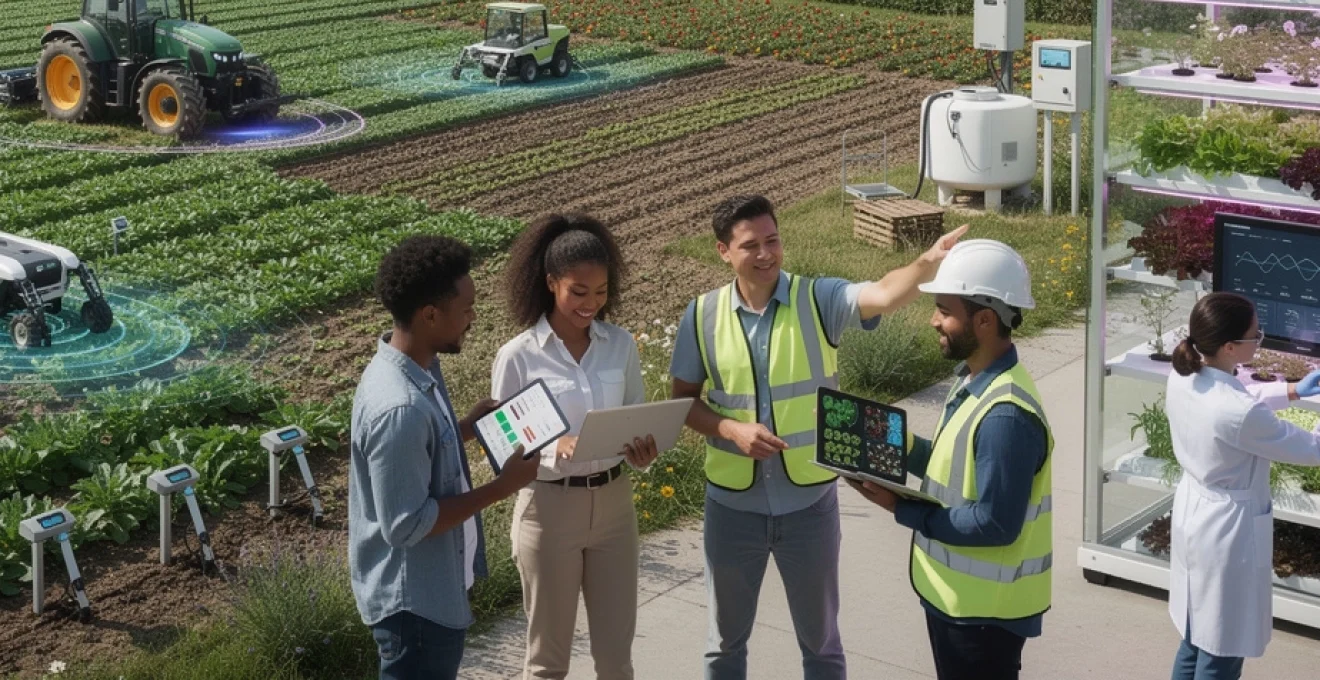
The convergence of agriculture and technology has created an unprecedented transformation in how we produce food and manage natural resources. With global population projections reaching 9.7 billion by 2050 and climate change threatening traditional farming methods, the agricultural sector is experiencing a revolutionary shift towards sustainable, technology-driven solutions. This transformation isn’t merely about adopting new tools—it represents a fundamental reimagining of agricultural practices that promises to address food security whilst reducing environmental impact. For those entering the workforce today, this evolution presents extraordinary opportunities to build meaningful careers that directly contribute to planetary sustainability and human welfare.
The agricultural technology sector now encompasses an astonishing breadth of specialisations, from robotics engineers designing autonomous harvesters to geneticists developing climate-resilient crops. These roles demand diverse skill sets spanning computer science, environmental science, engineering, biotechnology, and data analytics. What makes these careers particularly compelling is their dual promise: they offer intellectually stimulating work at the cutting edge of innovation whilst providing tangible solutions to humanity’s most pressing challenges. Whether you’re passionate about coding algorithms, fascinated by plant biology, or driven to combat climate change, the agri-tech sector offers pathways that align technical expertise with environmental stewardship.
Precision agriculture technologies transforming modern farming practices
Precision agriculture represents a paradigm shift from traditional farming’s one-size-fits-all approach to highly targeted, data-driven cultivation strategies. This sector combines advanced sensors, satellite imagery, artificial intelligence, and robotics to optimise every aspect of agricultural production. The result is farming that uses fewer resources whilst producing higher yields—a combination essential for sustainable food production. Careers in precision agriculture typically require backgrounds in engineering, computer science, or agricultural sciences, with specialists working across hardware development, software engineering, data analysis, and field implementation.
Iot sensors and remote monitoring systems for crop health management
Internet of Things (IoT) technology has revolutionised how farmers monitor crop health and environmental conditions. Modern agricultural operations deploy networks of sensors throughout fields, continuously collecting data on soil moisture, nutrient levels, temperature, humidity, and plant health indicators. These sensors transmit information to cloud-based platforms where algorithms analyse patterns and alert farmers to potential issues before they become visible to the human eye. Careers in this specialisation include IoT hardware engineers who design robust, weather-resistant sensors capable of operating in harsh agricultural environments, and software developers who create the platforms that transform raw sensor data into actionable insights.
The deployment of remote monitoring systems has proven particularly valuable in reducing water consumption—a critical consideration as agricultural water use accounts for approximately 70% of global freshwater withdrawals. By precisely measuring soil moisture at various depths and locations, these systems enable irrigation only when and where needed, often reducing water use by 20-40% whilst maintaining or improving crop yields. For professionals entering this field, understanding both the technical aspects of sensor networks and the practical realities of farm operations creates valuable expertise that bridges engineering and agriculture.
Gps-guided autonomous tractors and robotic harvesting equipment
Autonomous agricultural machinery represents one of the most visible manifestations of precision agriculture technology. GPS-guided tractors can now operate with centimetre-level accuracy, following optimised paths that minimise soil compaction and fuel consumption whilst maximising field coverage efficiency. These systems integrate multiple technologies including RTK (Real-Time Kinematic) GPS, machine vision, LIDAR, and sophisticated control algorithms. Engineers specialising in autonomous agricultural vehicles work on challenges ranging from path planning algorithms that account for irregular field boundaries to safety systems that detect and respond to unexpected obstacles like wildlife or farm workers.
Robotic harvesting systems address one of agriculture’s most persistent challenges: the labour-intensive nature of harvesting delicate crops like strawberries, apples, or lettuce. These robots use computer vision to identify ripe produce, sophisticated end-effectors to grasp fruit without damaging it, and machine learning algorithms that improve picking efficiency over time. The development of agricultural robotics requires interdisciplinary teams including mechanical engineers, computer vision specialists, machine learning experts, and agricultural advisors who understand crop-specific requirements. As these technologies mature, career opportunities extend beyond initial development to include system integration, maintenance, and optimisation for specific crop varieties and growing conditions.
Variable rate technology applications in fertiliser and pesticide distribution
Variable rate technology (VRT) enables farmers to apply inputs
Variable rate technology (VRT) enables farmers to apply inputs such as fertilisers, lime, and crop protection products at different rates across a single field, based on detailed maps of soil properties and crop needs. Instead of treating an entire field as uniform, agronomists use yield maps, soil sampling data, and remote sensing to create prescription maps that guide equipment in real time. This targeted approach can reduce fertiliser and pesticide use by 10–30%, cutting costs whilst lowering nutrient runoff and greenhouse gas emissions. Careers in VRT span precision agronomy, GIS mapping, and control systems engineering, with professionals working closely with farmers to interpret data and fine-tune application strategies.
Implementing variable rate fertiliser and pesticide distribution requires both technical and practical expertise. Specialists must understand how to calibrate spreaders and sprayers, integrate GPS guidance systems, and ensure that application equipment responds correctly to prescription maps. They also need strong communication skills to explain the benefits and limitations of VRT to farm managers who may be used to conventional methods. For those interested in sustainable agriculture technology, VRT roles offer an opportunity to directly influence how resources are used on the ground and to demonstrate measurable improvements in both productivity and environmental performance.
Drone-based multispectral imaging for yield prediction and field mapping
Unmanned aerial vehicles (UAVs), commonly known as drones, are now mainstream tools for precision agriculture and green tech innovation. Equipped with multispectral and hyperspectral cameras, drones capture detailed images that reveal plant health indicators such as chlorophyll content, water stress, and disease onset long before they are visible at ground level. These images are processed into vegetation indices like NDVI (Normalised Difference Vegetation Index), which agronomists and data analysts use to assess crop variability, predict yields, and identify zones that need targeted intervention. As a result, drone-based imaging supports more precise fertiliser application, irrigation scheduling, and crop protection decisions.
Careers in this area combine aviation regulations, remote sensing, and data analytics. Drone pilots must be certified and familiar with flight planning, safety protocols, and local airspace rules, whilst remote sensing specialists interpret the spectral data and translate it into meaningful recommendations for farmers. Software developers and GIS analysts develop platforms that stitch images into high-resolution field maps and overlay them with other datasets, such as soil maps or historic yield data. If you enjoy working at the intersection of hardware, software, and environmental science, drone-based agricultural imaging offers a dynamic, fast-growing career path.
Machine learning algorithms in soil analysis and irrigation optimisation
Machine learning is transforming how we understand soil health and manage irrigation, turning thousands of data points into clear, actionable guidance. Algorithms can analyse historical weather patterns, soil texture, organic matter content, and sensor readings to predict how water and nutrients move through the soil profile. In practice, this means irrigation scheduling systems that recommend when to water, how much to apply, and which parts of a field need more or less moisture. By optimising irrigation, farms can save up to 25–40% of water use in some cropping systems, making this a critical technology for climate-resilient agriculture.
Professionals in this space typically have backgrounds in data science, environmental engineering, or agronomy, with strong skills in programming languages such as Python or R. They build and train models, validate them with field data, and work closely with growers to adapt algorithms to local conditions. Think of it as giving fields a “smart thermostat”: instead of guessing when plants are thirsty, you’re using real-time and historical data to get it right most of the time. For those who enjoy problem-solving and want to apply machine learning to real-world environmental challenges, agricultural analytics offers meaningful and impactful work.
Vertical farming systems and controlled environment agriculture careers
Vertical farming and controlled environment agriculture (CEA) are redefining what it means to grow food, shifting production from open fields to highly controlled indoor spaces. These systems stack crops in multiple layers and use climate control, artificial lighting, and recirculating water systems to produce food year-round, often in or near cities. Vertical farms can use up to 95% less water than traditional agriculture and substantially reduce the need for pesticides, whilst shortening supply chains and improving freshness. As urban populations grow and climate extremes become more common, careers in CEA and vertical farming are becoming central to discussions around sustainable food systems.
The vertical farming sector offers roles for engineers, horticulturists, data scientists, and operations managers, all working together to fine-tune plant growth conditions. Because these environments are so tightly controlled, even small adjustments in temperature, nutrient composition, or light intensity can significantly affect yields and energy use. If you’re interested in combining plant science with advanced engineering and automation, this field provides an opportunity to help design the farms of the future, often in the heart of our cities rather than in remote rural areas.
Hydroponic and aeroponic growing systems engineering
Hydroponic and aeroponic systems replace soil with nutrient-rich water solutions or nutrient mist, allowing plants to grow with highly efficient use of water and fertilisers. In hydroponics, plant roots are submerged or periodically flooded with solution, while in aeroponics, roots are suspended in air and sprayed with a fine mist—some systems can achieve up to 90% water savings compared with soil-based methods. Designing these systems requires careful attention to fluid dynamics, nutrient dosing, system hygiene, and redundancy, as even brief interruptions in water or nutrients can stress or kill crops. Engineers and technicians in this area play a crucial role in ensuring continuous operation and consistent plant performance.
Careers in hydroponic and aeroponic engineering blend mechanical design, plumbing, electrical systems, and plant physiology. Professionals may design modular grow systems, specify pumps and filtration units, or develop automated dosing systems that maintain optimal nutrient balance. They also collaborate closely with horticulturists who monitor plant responses and fine-tune recipes for different crops, from leafy greens to strawberries and herbs. If you enjoy the challenge of designing closed-loop systems and solving problems such as root oxygenation or pathogen control, hydroponics and aeroponics offer hands-on roles at the forefront of sustainable agriculture technology.
LED spectrum optimisation for indoor crop production
Light-emitting diode (LED) technology has made indoor farming commercially viable by dramatically reducing energy consumption compared with older lighting systems. However, LEDs do more than simply provide light—they can be tuned to specific wavelengths that influence plant growth, flavour, colour, and nutrient content. Specialists in spectrum optimisation study how different combinations of red, blue, green, and far-red light affect photosynthesis and plant morphology, then design lighting strategies that maximise yield per kilowatt-hour. In some vertical farms, lighting can account for more than half of operating costs, so even modest efficiency gains translate into significant savings and a lower carbon footprint.
Careers in LED optimisation sit at the intersection of plant science, physics, and electrical engineering. Professionals may use modelling tools to simulate light distribution in multilayer systems, run experiments to compare growth under different spectra, or work with manufacturers to develop new fixtures tailored to specific crops. For those interested in green tech and renewable energy integration, this field offers a chance to reduce the environmental impact of indoor farms and make sustainable food production more accessible. It’s a bit like being a “lighting composer” for plants, orchestrating the perfect mix of wavelengths to get the best possible performance.
Climate control automation and HVAC design for urban farms
Controlled environment agriculture depends heavily on reliable heating, ventilation, and air conditioning (HVAC) systems to maintain optimal temperature, humidity, and CO₂ levels. Poor climate control can result in slower growth, disease outbreaks, and wasted energy, so efficient HVAC design is central to sustainable vertical farming. Engineers in this field design air distribution systems, select dehumidification and cooling equipment, and integrate sensors and automation that adjust conditions in real time. They must balance plant needs with energy efficiency, often using heat recovery, variable-speed fans, and smart controls to minimise emissions.
Automation specialists develop the control algorithms that manage climate systems, integrating data from temperature, humidity, and CO₂ sensors into building management software. They may also connect climate controls with irrigation and lighting systems, creating fully integrated “digital greenhouses” that respond dynamically to changing conditions. For professionals with a background in mechanical engineering, building services, or mechatronics, these roles offer a way to apply their expertise to food production and climate action. If you’ve ever wondered how to keep a glasshouse at the perfect conditions on a scorching summer day or during a freezing winter night, this is where those real-world challenges are solved.
Aerofarms and plenty unlimited career pathways in commercial vertical farming
Leading companies such as AeroFarms and Plenty Unlimited have pioneered large-scale vertical farming, offering a glimpse into the types of careers that will shape the future of sustainable food. These organisations employ a wide range of professionals, from plant scientists developing new crop varieties suited to indoor conditions, to software engineers building the data platforms that control every aspect of the farm. Operations managers ensure smooth production, quality assurance teams maintain food safety standards, and sustainability officers track environmental performance and carbon footprints. Together, they demonstrate how multidisciplinary a modern agricultural career can be.
For students and early-career professionals, these companies often provide internships, graduate schemes, or entry-level positions in areas such as farm operations, R&D, automation engineering, or data analytics. Career pathways may begin on the farm floor, monitoring crops and systems, and progress into specialised technical or leadership roles over time. When you think about working in agriculture, you might picture open fields, but companies like AeroFarms and Plenty reveal that tomorrow’s farms can look more like high-tech laboratories or advanced manufacturing plants. Joining such organisations allows you to contribute directly to sustainable food production while gaining exposure to cutting-edge agricultural technology.
Renewable energy integration in agricultural operations
Energy use is a major cost and carbon source in agriculture, from powering irrigation pumps and cold storage to running machinery and processing facilities. Integrating renewable energy into farm operations is therefore a key strategy for building a low-carbon, resilient food system. Solar panels, biogas digesters, wind turbines, and battery storage systems can turn farms into clean energy producers rather than just consumers. As governments and financial institutions increasingly support the energy transition, demand is rising for professionals who understand both agricultural systems and renewable energy design.
Careers in this domain range from renewable energy engineers and project managers to energy auditors and policy specialists. These professionals assess a farm’s energy demand, resource availability (such as sunlight, wind, or organic waste), and financial constraints, then design systems that deliver reliable power with minimal emissions. If you’re interested in how to decarbonise food production whilst improving farm profitability, renewable energy integration offers a compelling and impactful career pathway.
Solar panel installation and agrivoltaics system design
Solar photovoltaic (PV) systems have become one of the most accessible renewable energy options for farms, providing clean electricity for pumps, refrigeration, and on-site processing. Beyond traditional rooftop or ground-mounted arrays, agrivoltaics—integrating solar panels directly into crop or livestock systems—is an emerging field with strong growth potential. In agrivoltaic setups, panels are elevated or spaced to allow crops or grazing animals underneath, creating a dual-use system that generates energy whilst maintaining agricultural productivity. Some studies suggest that certain crops can even benefit from partial shading, particularly in hot, arid regions where high temperatures limit yields.
Solar and agrivoltaic system designers work with farmers to determine panel layout, mounting structures, and electrical connections that suit existing operations. They must consider factors such as machinery access, crop light requirements, and animal behaviour, alongside grid connection and regulatory approvals. Solar installers and technicians handle the physical installation, commissioning, and maintenance of these systems, often needing knowledge of both electrical safety and farm-specific hazards. For those who enjoy practical fieldwork and want to accelerate the transition to renewable energy in agriculture, this is a hands-on, rapidly expanding career area.
Biogas production from agricultural waste and anaerobic digestion
Biogas systems turn agricultural waste—such as manure, crop residues, and processing by-products—into renewable energy through anaerobic digestion. In sealed tanks, microorganisms break down organic material in the absence of oxygen, producing biogas (mainly methane and carbon dioxide) and digestate, a nutrient-rich by-product that can be used as fertiliser. This process reduces methane emissions from manure storage, displaces fossil fuels, and closes nutrient loops on the farm. In regions with supportive policy frameworks, biogas plants can also sell surplus electricity or biomethane to the grid, creating an additional revenue stream for farmers.
Careers in biogas production span process engineering, microbiology, plant operations, and project finance. Engineers design digesters, gas handling systems, and safety mechanisms, while operators monitor feedstock quality, biogas production, and equipment performance. Environmental specialists evaluate emissions reductions and nutrient management benefits, ensuring compliance with regulations. If you like the idea of turning waste into a valuable resource and contributing to the circular economy, working in anaerobic digestion and biogas offers a direct way to support sustainable agriculture and energy systems.
Wind turbine deployment for off-grid farm energy independence
In windy regions, small- and medium-scale wind turbines can provide a reliable source of renewable energy for farms, reducing dependence on diesel generators or unstable grid connections. For remote or off-grid agricultural operations, wind power can be particularly valuable, supporting irrigation, processing, and refrigeration without the need for expensive fuel deliveries. Farm-based wind systems range from single turbines powering specific loads to larger installations that feed into local microgrids, sometimes combined with solar PV and battery storage for a more stable supply.
Wind energy professionals working with agricultural clients may focus on site assessment, turbine selection, foundation design, and grid or microgrid integration. They must analyse wind resource data, assess potential environmental impacts (including on wildlife), and navigate planning and permitting processes. Technicians are responsible for installation, routine maintenance, and troubleshooting, often working at height and in challenging conditions. For those interested in engineering and field-based work, helping farms become more energy independent through wind power can be a highly rewarding career path.
Battery storage solutions and microgrid management for rural properties
As farms adopt more renewable energy, managing variability and ensuring reliable power becomes crucial. Battery storage systems, often lithium-ion or emerging alternatives, allow farms to store excess electricity from solar or wind during peak production and use it when generation drops or demand increases. When combined with smart inverters and control software, battery systems can form the backbone of a microgrid—an integrated, local energy network that can operate either connected to or independent from the main grid. This is especially valuable for rural properties where grid reliability may be limited.
Careers in battery storage and microgrid management involve electrical engineering, software development, and energy systems analysis. Professionals design and size battery banks, develop control algorithms that balance generation and load, and implement monitoring platforms that give farmers real-time insight into their energy use. Think of a farm microgrid as a “digital brain” for energy: it decides when to charge or discharge batteries, when to run generators, and how to prioritise critical loads like cold storage. For those passionate about both clean energy and resilient rural communities, this field offers cutting-edge technical work with tangible local benefits.
Regenerative agriculture and carbon sequestration specialists
Regenerative agriculture focuses on restoring soil health, enhancing biodiversity, and increasing the land’s capacity to store carbon, turning farms into allies in the fight against climate change. Instead of relying on intensive tillage and heavy chemical inputs, regenerative practices prioritise minimal soil disturbance, permanent ground cover, diverse crop rotations, and integrated livestock. These methods can improve water retention, reduce erosion, and build soil organic matter, which acts as a major carbon sink. As governments and companies explore nature-based climate solutions, specialists in regenerative agriculture and carbon sequestration are in growing demand.
Professionals in this area come from backgrounds in soil science, ecology, agronomy, and environmental policy. They work directly with farmers to design regenerative management plans, measure soil carbon changes, and access emerging markets for ecosystem services. If you want a career that combines hands-on fieldwork with climate mitigation and adaptation, regenerative agriculture offers a powerful way to contribute to a sustainable future.
No-till farming techniques and soil microbiome restoration
No-till or reduced-till farming minimises soil disturbance by planting crops directly into residue from previous harvests, rather than ploughing the soil each season. This approach helps maintain soil structure, protect beneficial fungi and bacteria, and reduce carbon losses from the soil to the atmosphere. Over time, no-till systems can increase soil organic matter, improve water infiltration, and reduce erosion—benefits that are crucial in the face of more frequent droughts and heavy rainfall events. However, transitioning to no-till requires changes in equipment, weed management strategies, and fertiliser placement, so technical guidance is essential.
Soil health specialists and regenerative agronomists support farmers through this transition, helping them understand the complex soil microbiome and how management practices affect it. They may use soil testing, cover crop integration, and residue management recommendations to build microbial diversity and function. You can think of the soil microbiome as the farm’s “hidden workforce”: trillions of organisms that cycle nutrients, build structure, and support plant health. Careers focused on soil restoration allow you to work at this microscopic frontier, translating scientific insights into practical, climate-smart farming techniques.
Cover cropping strategies and biodiversity enhancement programmes
Cover crops—plants grown primarily to protect and improve the soil rather than for harvest—are a cornerstone of regenerative agriculture. Species such as clover, rye, vetch, and radish can fix nitrogen, break up compacted layers, reduce erosion, and provide habitat for beneficial insects. Carefully designed cover crop mixes can increase biodiversity both above and below ground, supporting pollinators and natural enemies of pests. Yet effective cover cropping is not one-size-fits-all; it must be tailored to local climates, soil conditions, and crop rotations to avoid issues such as water competition or difficult termination.
Regenerative agriculture consultants, conservation agronomists, and biodiversity officers work with farmers to design and implement cover cropping and habitat enhancement programmes. They may advise on species selection, seeding rates, planting dates, and termination methods, as well as monitor outcomes for soil health and wildlife. These roles often involve collaboration with conservation charities, water companies, and government agencies seeking to improve landscape-level ecosystem services. If you’re drawn to field-based work and enjoy seeing tangible ecological improvements, specialising in cover cropping and biodiversity restoration can be deeply fulfilling.
Carbon credit trading and verification for agricultural landholders
As interest in carbon markets grows, agricultural landholders are increasingly exploring opportunities to earn income from practices that sequester carbon or reduce emissions. Programmes may offer carbon credits for activities such as adopting no-till, planting trees or hedgerows, improving pasture management, or installing methane-reducing technologies. However, ensuring that these credits represent real, additional, and verifiable climate benefits requires robust measurement, reporting, and verification (MRV) frameworks. This has created new career opportunities at the intersection of agriculture, finance, and environmental science.
Carbon project developers, verifiers, and MRV specialists design protocols, collect field data, and use modelling tools to estimate changes in soil carbon or emissions. They then work with registries and buyers to issue and trade carbon credits. Policy experts and legal advisers help navigate evolving regulations and ensure that farmers understand contractual obligations and risks. For those interested in climate policy, sustainable finance, and land management, working in agricultural carbon markets offers a way to help direct funding towards climate-smart farming while maintaining scientific integrity.
Agricultural biotechnology and genetic engineering roles
Agricultural biotechnology leverages advances in genetics, molecular biology, and microbiology to improve crops, livestock, and agricultural inputs. From developing drought-tolerant maize to bio-based fertilisers and biopesticides, biotech innovations aim to increase yields, reduce environmental impacts, and enhance nutritional quality. With climate change intensifying stresses such as heat, salinity, and emerging pests and diseases, the need for resilient crop varieties and sustainable inputs has never been greater. Careers in this field are diverse, spanning laboratory research, regulatory affairs, product development, and field trials.
Professionals working in agricultural biotech may be based in universities, public research institutes, or private companies ranging from global seed firms to start-ups. Roles often require advanced degrees in plant science, molecular biology, or related disciplines, but there are also opportunities for technicians, data managers, and field agronomists. If you’re fascinated by the inner workings of plants and microbes and want to see your work translated into real-world solutions, agricultural biotechnology offers a rich and impactful career landscape.
CRISPR gene editing applications in drought-resistant crop development
CRISPR-Cas gene editing has revolutionised plant breeding by enabling precise, targeted changes to DNA without introducing foreign genes. This technology is being used to develop crops that can better withstand drought, heat, and other stresses associated with climate change. For example, scientists can edit genes that regulate stomatal opening, root architecture, or osmotic balance, helping plants use water more efficiently and maintain yields under limited moisture conditions. Compared with traditional breeding, CRISPR can dramatically shorten development timelines, allowing more rapid responses to evolving environmental challenges.
Careers in CRISPR-based crop improvement span molecular biologists, bioinformaticians, and plant breeders. Laboratory scientists design and execute gene editing experiments, while bioinformaticians analyse genomic data to identify target genes and assess off-target effects. Plant breeders then integrate edited traits into elite varieties and evaluate them in greenhouse and field trials. There are also regulatory and ethics specialists who navigate differing national frameworks and public concerns around gene-edited crops. For those keen to work at the cutting edge of science and climate resilience, CRISPR applications in agriculture are among the most exciting frontiers.
Biopesticide formulation and integrated pest management research
Biopesticides—derived from natural materials such as microbes, plant extracts, or minerals—offer an alternative to conventional synthetic pesticides, often with lower toxicity and environmental persistence. They can target specific pests or diseases while minimising harm to beneficial insects and other non-target organisms. Developing effective biopesticides requires identifying active agents, formulating them for stability and field performance, and integrating them into broader integrated pest management (IPM) strategies. IPM focuses on combining biological, cultural, mechanical, and chemical tools to keep pest populations below damaging levels with minimal environmental impact.
Professionals in this area include microbiologists isolating beneficial bacteria or fungi, chemists working on formulations, and field researchers testing products under different conditions. Extension specialists and IPM advisers then help farmers integrate these tools into practical pest management programmes, often in response to growing regulatory restrictions on certain synthetic products. If you’re drawn to ecology and want to help design pest control systems that work with, rather than against, natural processes, careers in biopesticides and IPM research provide a compelling route.
Plant-based alternative protein development at impossible foods and beyond meat
The rapid growth of plant-based meat and dairy alternatives is reshaping global protein markets and offering new ways to reduce the environmental footprint of food systems. Companies such as Impossible Foods and Beyond Meat use advanced food science, plant protein chemistry, and sensory research to create products that closely mimic the taste and texture of animal-based foods. This sector is not strictly “agriculture” in the traditional sense, but it depends heavily on crop supply chains and agricultural innovation, particularly in protein-rich crops like peas, soy, and fava beans.
Careers in plant-based protein development span food technologists, flavour scientists, process engineers, and sustainability analysts. R&D teams experiment with different protein sources, functional ingredients, and processing techniques to improve product quality and nutritional profiles. Supply chain specialists work with farmers and ingredient suppliers to secure sustainable, traceable raw materials, while life-cycle assessment experts quantify environmental impacts such as greenhouse gas emissions and land use. If you want to contribute to more sustainable diets and help reduce pressure on land and water resources, the alternative protein sector offers a range of roles that connect agriculture, food tech, and sustainability.
Synthetic biology approaches to nitrogen fixation enhancement
Nitrogen fertiliser is essential for modern crop production but is also a major source of greenhouse gas emissions and water pollution. Synthetic biology aims to address this challenge by engineering microbes or plants to fix atmospheric nitrogen more efficiently, reducing the need for synthetic fertilisers. Researchers are exploring ways to transfer or enhance nitrogen-fixing capabilities in non-legume crops, design microbial consortia that colonise roots and supply nitrogen, and develop biofertilisers that are more predictable and effective. This work is technically demanding but could have transformative impacts on sustainable agriculture if successful.
Roles in this niche field include synthetic biologists, metabolic engineers, and microbial ecologists working in interdisciplinary teams. They design genetic circuits, construct and test engineered organisms, and study their interactions with plants and soil communities. Regulatory specialists and risk assessors evaluate biosafety considerations and public acceptance, given the novelty of some approaches. For those interested in deep science with enormous potential to reduce agriculture’s environmental footprint, synthetic biology for nitrogen fixation represents a bold and innovative career direction.
Data science and agricultural analytics career opportunities
The digital transformation of agriculture has generated vast amounts of data—from satellite imagery and in-field sensors to machinery telematics and market feeds. Data science and agricultural analytics harness this information to support better decisions at every level, from individual farms to global supply chains. Whether it’s predicting yield, optimising logistics, or assessing climate risks, data-driven insights are becoming central to sustainable, resilient food systems. As a result, demand is rising for professionals who can bridge the gap between advanced analytics and practical agricultural knowledge.
Careers in this area include data scientists, GIS analysts, software developers, and agri-business strategists. These professionals work in agri-tech start-ups, cooperatives, food companies, banks, and government agencies, building tools and models that guide investment and management decisions. If you enjoy coding, statistics, and problem-solving, and you want your work to have real-world environmental and social impact, agricultural analytics is a field where your skills can make a tangible difference.
Predictive modelling for commodity price forecasting and risk management
Agricultural markets are inherently volatile, influenced by weather events, policy changes, currency fluctuations, and shifting consumer preferences. Predictive modelling helps farmers, traders, and policymakers anticipate price movements and manage risks more effectively. By combining historical price data with climate models, crop condition reports, and macroeconomic indicators, data scientists build models that forecast commodity prices and yield scenarios. These insights can inform decisions such as when to sell, how much to store, or whether to hedge using futures contracts or insurance products.
Professionals working in this area often have backgrounds in economics, statistics, or quantitative finance, alongside an understanding of agricultural fundamentals. They may develop dashboards and tools for cooperatives or financial institutions, run scenario analyses for large agribusinesses, or advise governments on food security planning. For those who enjoy working with complex datasets and uncertainty, predictive modelling provides a critical service: helping the agricultural sector navigate an increasingly unpredictable world while supporting more stable, sustainable supply chains.
Blockchain technology in supply chain traceability and food safety
Blockchain technology offers a way to create transparent, tamper-resistant records of transactions and product movements across the food supply chain. By recording data on where and how food was produced, processed, and transported, blockchain-based systems can improve traceability, support sustainability claims, and enhance food safety. In the event of a contamination incident, for example, blockchain can help rapidly identify affected batches and their origins, reducing waste and protecting consumers. It can also support certification schemes for organic, fair trade, or low-carbon products by providing verifiable records.
Careers in blockchain for agriculture involve software developers, systems architects, and supply chain specialists. They work with farmers, processors, retailers, and regulators to design and implement platforms that are secure, user-friendly, and integrated with existing systems such as barcodes or IoT sensors. Business analysts and sustainability professionals also play a role in defining data standards and governance rules to ensure that traceability systems deliver real value rather than just additional complexity. If you’re interested in digital trust, ethical supply chains, and consumer transparency, working at the interface of blockchain and agriculture offers innovative and socially significant opportunities.
Geographic information systems for land use planning and resource allocation
Geographic Information Systems (GIS) are essential tools for analysing spatial data and making informed decisions about land use, water resources, and infrastructure in agriculture. GIS specialists combine satellite imagery, topographic maps, soil surveys, and climate data to identify the most suitable areas for particular crops, design efficient irrigation schemes, and assess environmental risks such as erosion or flooding. At a regional or national scale, GIS supports strategic planning for food production, conservation, and climate adaptation, helping to balance competing demands on land.
Professionals in this field may work for government agencies, consulting firms, NGOs, or private agribusinesses. They build and maintain spatial databases, create maps and visualisations, and run spatial analyses that inform policy and investment decisions. For example, GIS can help identify where regenerative agriculture programmes would deliver the greatest benefits, or where new storage facilities would most reduce post-harvest losses. If you’re visually oriented and enjoy seeing patterns emerge from complex data, a career in GIS and land use planning allows you to play a key role in shaping more sustainable and resilient agricultural landscapes.